
Armstrong Parole Versus Probation
Parole and probation can both place a released person under rules in the community, but they arise from different legal events. State parole follows release from a Pennsylvania state correctional institution before the maximum sentence expires. The Pennsylvania Parole Board makes that decision, and Pennsylvania Department of Corrections agents provide supervision. Probation is a sentence or part of a sentence imposed by a court. Armstrong County Probation handles local supervision ordered by the Court of Common Pleas. PA DOC states that it generally has no authority over county probation or county parole offices.
A person may leave Armstrong County Jail and report to county probation without ever appearing as a state parolee. Another person may leave the jail only because of a transfer into PA DOC custody. That transfer is not community release. Later, if the Parole Board grants release from a state prison, the person can serve the unexpired term under state parole supervision through the maximum date. Use the order, agency, and custody history together.
| Point | State parole | County probation |
|---|---|---|
| How it begins | Parole Board grant after a state sentence | Sentence or order from the Armstrong County court |
| Who supervises | PA DOC parole agents | Armstrong County Probation |
| Public lookup | DOC locator may show supervision details | No public probationer-name search was found |
| Primary proof | Board Action, DOC record, and district office | Sentencing docket and county office confirmation |
- Parole
- Conditional community release before a state sentence reaches its maximum.
- Probation
- Court-ordered community supervision imposed instead of, or after, confinement.
- Discharge
- The formal end of supervision after the controlling term and conditions are satisfied.
- Absconder
- A supervised person reported as having stopped contact or left supervision without approval.
Verify Armstrong Post-Release Supervision
Begin with the sentence, not an assumption based on where the person lives. The Unified Judicial System Case Search can show an Armstrong County disposition, sentence, probation term, revocation filing, and related docket activity. A Common Pleas docket may point toward county probation or a state commitment. It does not show the physical minute of jail release. Match the full name, date of birth when available, docket number, and offense record before relying on the result.
- Identify whether the sentence is county or state. Read the sentencing order and commitment entries instead of treating release from Armstrong County Jail as proof of parole.
- For a state sentence, search both populations in the PA DOC Inmate/Parolee Locator. Use the inmate or parole number when known, or start with the last name.
- Open the matching department-supervised result. Compare the committing county, date of birth, current or permanent location, Release Date, and District Office.
- Use the PA DOC parole office finder for the office named in the record. Do not infer assignment from an Armstrong address alone.
- For county probation, review the Armstrong docket and contact Armstrong County Probation for the public verification process. No open county name-search tool was found.
The locator is a convenience source, not a certified sentence-status document. Some personal details can originate outside DOC and may not be independently verified. A blank result can mean the person had only a county term, completed supervision, is outside public coverage, or was searched under the wrong spelling. An actual agency record or court order carries more weight.
Note: Search incarcerated and department-supervised populations separately because a parolee may no longer appear on the inmate side of the locator.
Armstrong County Probation Contact
Local supervision starts with Armstrong County Probation when a county court order controls. The office can explain its process for confirming supervision, but it does not publish a general public list of people on probation. Ask a narrow question and provide enough information to distinguish people with similar names. The docket number is useful. Public access rules may limit what staff disclose by telephone.
Armstrong County ProbationRegina Himes, Chief Probation Officer
500 East Market Street, Suite 303
Kittanning, PA 16201
Phone: 724-548-3491
Fax: 724-548-3460
State parole is routed differently. An assigned district office may appear in the PA DOC locator, and that named office should be used. A planned residence in Armstrong County does not prove which parole office holds the case because approved home plans and supervision structure can affect assignment. If a public result omits the agent, contact the listed district office for its public verification policy.
Armstrong Supervision and Absconders
Conditions are rules attached to supervision. They can include reporting, approved residence, treatment, travel limits, testing, electronic monitoring, or other terms in an order. The exact terms come from the controlling court or parole record. A violation allegation does not itself tell whether the person has returned to custody. It may lead to an agency warrant, detention, a hearing, continued supervision, or recommitment, depending on the case.
A PA DOC locator result can display “Wanted: Parole Absconder.” The locator legend also uses an asterisk for an absconder. That status concerns state parole. Armstrong County has no public probation absconder list, and the District Attorney’s Crimewatch channel is not a complete parole or probation database. A local warrant post can establish that the issuing agency reports someone wanted, but it does not prove the original release date or present supervision type.
Parole violation proceedings use separate terms. Recommitment means return to custody under the Board’s authority. Rescission means withdrawal of a parole grant before physical release because of new facts or conduct. A later review month is a future review point, not a promised exit. For state matters, the written Board Action or Board Decision is the most direct outcome record.
Armstrong Parole Decision Records
The Pennsylvania Parole Board process applies to state-sentenced people. Pennsylvania does not publish a searchable, person-by-person calendar of institutional parole interviews or an open archive of all individual decisions. Public Board business meetings are not those interviews. The Board of Pardons serves a different role involving clemency, commutation, and pardons. Its calendar is not a parole-hearing calendar.
An initial decision can grant or deny parole, or defer a final result while more information is gathered. Voting rules vary by case. Some matters require a majority of Board members, while other panels may require two favorable votes. A grant can come before physical release because program work, a home-plan review, a detainer, or another prerequisite remains. Confirm the written Board Action first, then check the DOC locator or agency record for the actual Release Date.
The official parole decision page is shown in the captured source below.
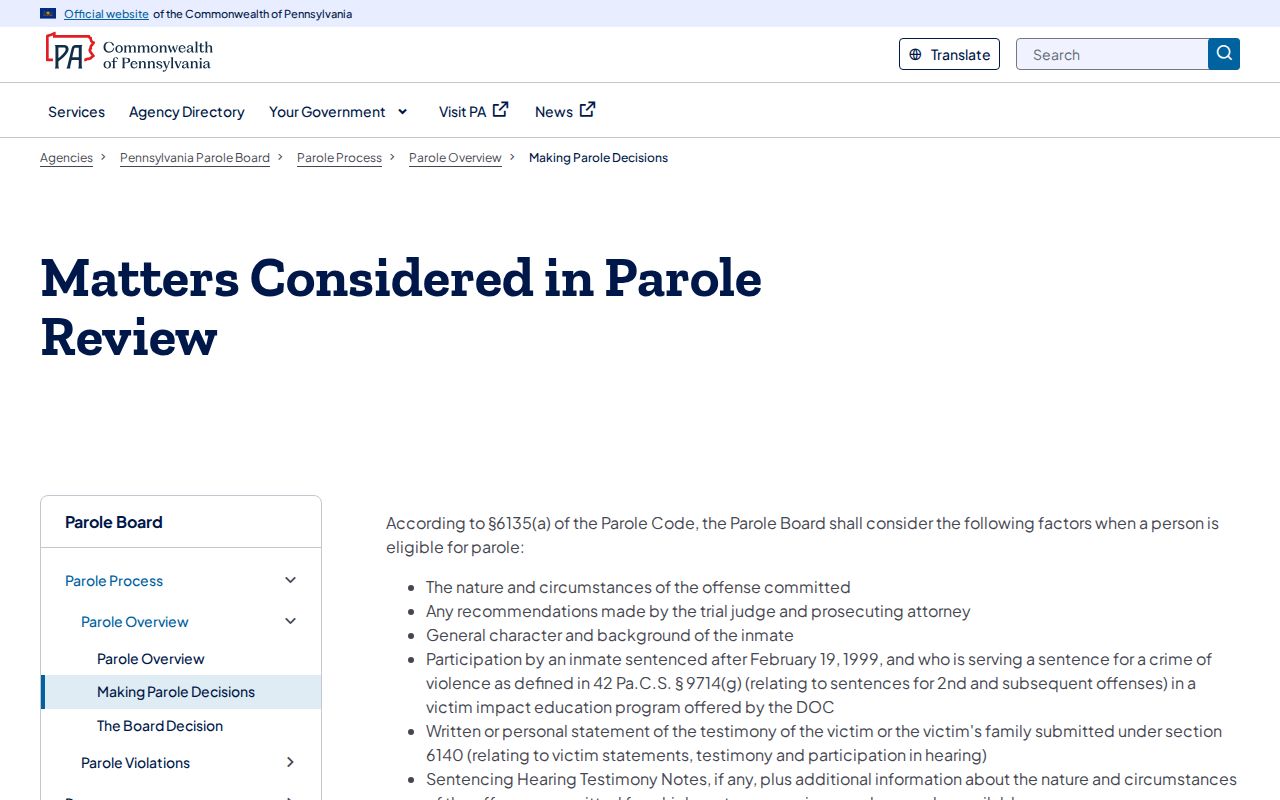
The source view helps separate a Board vote from the later physical release that must be confirmed through DOC.
Board decision-making records are not all open. Pennsylvania law restricts deliberative material and information supplied by public officials, while victim statements and contact details receive separate protection. A request should identify the specific record sought and should not assume that the full parole file is public.
Armstrong Intensive Supervision Path
Armstrong County’s Intensive Treatment and Supervision program is a distinctive local route. The county describes a continuum lasting about 18 to 24 months. It may begin with residential placement, move through a halfway house, and then shift to intensive community supervision with electronic monitoring. Placement is made through the Court of Common Pleas. Published eligibility is local and includes Armstrong County residence plus willingness to remain in the county.
This is not a general service for every person released from Armstrong County Jail. It is a structured court placement with its own eligibility and supervision terms. To verify participation, use the sentencing or later court order and the county office’s verification process. A jail departure, treatment referral, or electronic-monitoring reference alone does not establish every phase of the program.
Program status also differs from state parole. PA DOC will not normally supply the county program record. The Armstrong docket and probation office are the right channels. This distinction prevents a blank state locator search from being read as proof that no supervision exists.
Armstrong Release Property Deadlines
Supervision may start while practical release tasks remain. Armstrong County Jail publishes unusually specific property rules. Its inmate property policy gives 48 hours to pick up commissary delivered after release and states that general unclaimed property is disposed of after 30 days. A person collecting property for someone else must follow the jail’s identification and authorization rules.
The inmate accounts policy draws another useful line. A person released outright receives remaining funds by debit card. For a transfer to PA DOC, the jail handles a check through the receiving institution or last known address instead. These details can help clarify what occurred, but they are not substitutes for the release or transfer record.
Contact the jail promptly when property or funds remain unresolved. Do not treat the 48-hour and 30-day periods as retention rules for custody records. They govern physical items, while release records follow separate agency and public-record rules.
Note: A property rule may support the release trail, but only the custody record establishes the recorded release type and time.
Armstrong Supervision Discharge Records
Supervision ends through a formal agency or court event, not merely because a name disappears from a public search. For state parole, the unexpired part of the sentence is ordinarily served in the community through the maximum date unless a lawful recalculation, recommitment, or other action changes the status. The controlling DOC or Board record should show the outcome. “Release Date” in a parole locator record marks release from institutional custody, not final discharge from all supervision.
County probation ends under the Armstrong court order and county process. The UJS docket may show completion, revocation, modification, or another filed event, but limited access, sealing, or expungement can remove a case from public view. A blank docket is not a discharge certificate. Request the appropriate court or probation record when exact status matters.
For the earlier custody endpoint, use Armstrong County’s release record rather than a supervision database. The Armstrong County released-inmate search and records path explains how to distinguish outright release from transfer. Keeping the custody and supervision events separate produces a more accurate timeline.